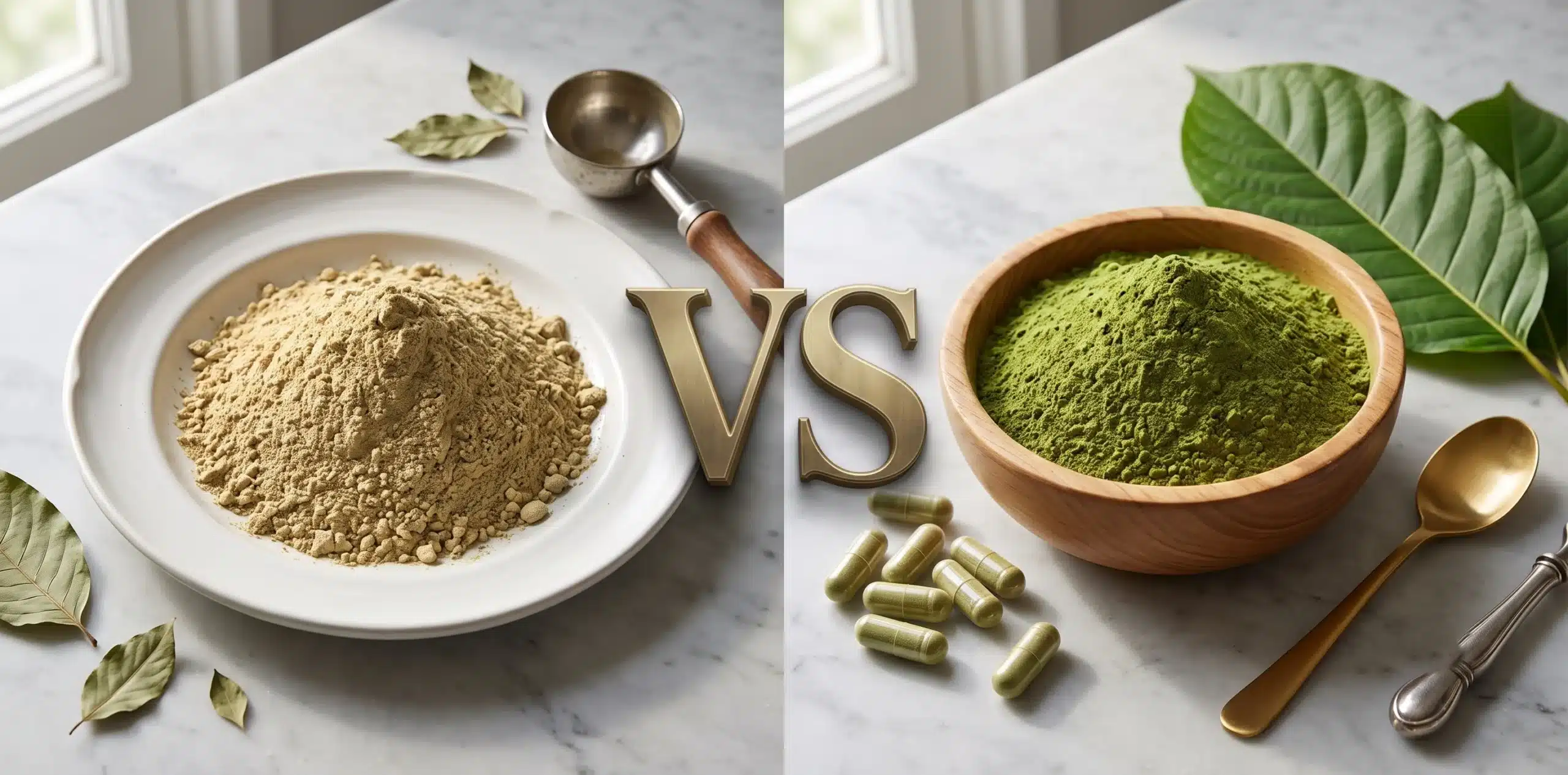
White vs Green Kratom is one of the most searched comparisons for anyone trying to understand Kratom color categories. At first, the difference may seem limited to the name, but both categories are shaped by leaf maturity, harvest timing, drying conditions, alkaloid composition, and strain classification.
Since both originate from the Mitragyna speciosa plant, the real distinction comes from how the leaves are selected and processed before becoming powders, capsules, or extracts. This guide breaks down the key differences between White and Green Kratom in a clear way.
Breaking Down The Differences: White vs Green Kratom
White Kratom and Green Kratom are two major Kratom color categories, both sourced from the Mitragyna speciosa tree. Let’s take a look at how they differ:
What Is White Kratom?
White Kratom comes from the youngest leaves of the Mitragyna speciosa tree. It comes from leaves harvested at an earlier growth stage and dried using methods that limit direct light exposure, which helps preserve a pale leaf-color classification.
What Is Green Kratom?
Green Kratom is harvested during the middle of the leaf maturity cycle, sitting exactly between the young white strains and fully mature red Kratom varieties. It relies on leaves dried indoors in controlled, dark environments to prevent oxidation, fully preserving the deep green color classification.
White vs Green Kratom: A Detailed Comparison
The main difference between White Kratom and Green Kratom comes from harvest timing, leaf maturity, drying method, alkaloid profile, and product presentation. Here is a closer look at each comparison point.
Leaf Maturity At Harvest
- White Kratom: It comes from the youngest leaves of the Mitragyna speciosa tree. These leaves are picked earlier in the leaf maturity cycle, before moving into later color stages.
- Green Kratom: It comes from leaves harvested during the middle stage of the maturity cycle. It sits between the younger white category and the red category.
Processing And Drying Method
- White Kratom: Dried indoors or in shaded, climate-controlled spaces with minimal sunlight exposure, a method tied to its lighter classification.
- Green Kratom: Dried through a combination of indoor drying and a shorter period of indirect outdoor exposure, contributing to its mid-range coloration.
Alkaloid Profile
Both White Kratom and Green Kratom contain naturally occurring Kratom alkaloids, including mitragynine and 7-hydroxymitragynine.
White Kratom:
- Young leaves at harvest carry a higher mitragynine concentration relative to 7-hydroxymitragynine.
- The light-limiting indoor drying method further preserves this early-stage ratio from heat degradation.
Green Kratom:
- Mid-maturity leaves have had more time for alkaloid development, producing a more balanced ratio of mitragynine to 7-hydroxymitragynine.
- Trace alkaloids (such as speciociliatine, paynantheine, and speciogynine) are also more fully developed at this stage.
Both White Kratom and Green Kratom strains are available in the given format:
- Kratom Powder: Dried Kratom leaves that are ground into a fine powder and are often available in different size options.
- Kratom Capsules: Kratom powder is filled into capsules for a pre-measured format. This is one of the most compact and mess-free formats of Kratom.
- Kratom Extracts: Kratom leaf material goes through additional processing to create a concentrated product.
Popularity and Availability
- White Kratom: Less common on the market because harvesting the youngest leaves requires specific timing, resulting in fewer regional variations.
- Green Kratom: Serves as the most widely available and heavily stocked Kratom category due to the larger number of green Kratom varieties produced across Southeast Asia’s major growing regions.
Popular Strain Varieties: White Kratom vs Green Kratom
Below listed are a few popular White and Green Kratom varieties available in the market:
White Kratom Strains:
- White Maeng Da: A grafted strain originally rooted in Thailand, now widely cultivated across Indonesian plantations.
- White Borneo: Harvested from the vast, humid rainforests of Borneo and processed indoors to preserve a distinctly high level of pure mitragynine.
- White Sumatra: Grown on Indonesia’s Sumatra island, one of the more traditional growing regions for this category.
- White Thai: A classic strain originally native to Thailand’s tropical climate, traditionally recognized for its rapid growth and distinct early-harvest timeline.
- White Elephant: Named for its unusually large, floppy and broad shaped leaves, and sourced primarily from Indonesian plantations.
| 👉 Learn more about White Kratom strains: |
Green Kratom Strains:
- Green Maeng Da: The later-harvested version of the same grafted Maeng Da lineage, picked at a more mature growth stage.
- Green Malay: Harvested from old-growth trees native to the rich, mountainous terrain of Malaysia.
- Green Bali: Typically grown in Sumatra or Borneo and historically shipped through the Bali port, which is how it got its name.
- Green Borneo: Cultivated from mid-lifecycle leaves along the riverbanks of the third-largest island in the world, optimizing a highly diverse trace alkaloid profile.
- Green Sumatra: Grown on Sumatra island, picked later in the leaf’s growth cycle than White Sumatra.
| 👉 Learn more about Green Kratom strains: |
Where To Buy White And Green Kratom?
Both White and Green Kratom strains are available through offline shops and online Kratom stores. Local shops allow in-person purchases, while online stores often make it easier to compare strain options, product formats, package sizes, and lab-related details before checkout.
At OKUSA, we offer a wide range of White and Green Kratom strains in powder and capsule formats. Other than strain variety, OKUSA also provides:
Key Takeaways: White vs Green Kratom
- White Kratom and Green Kratom both originate from the Mitragyna speciosa plant, but they differ by leaf maturity, harvest stage, and post-harvest processing.
- White Kratom comes from younger leaves, while Green Kratom comes from mid-maturity leaves between the white and red categories.
- Both categories contain mitragynine, 7-hydroxymitragynine, and trace alkaloids, though the exact composition may vary depending on strain type — including varieties such as Green Bali or White Maeng Da.
- Both categories share core strain names like Maeng Da, Borneo, and Sumatra, but each version reflects a different harvest and drying approach.
- White and Green Kratom strains are available in powder, capsule, and extract formats through both offline shops and online Kratom stores.
Frequently Asked Questions
1. Are Green And White Kratom Strains Legal?
Green and White Kratom strains are not banned at the federal level in the United States, but Kratom laws vary by state, county, and city. Some states restrict or ban Kratom, so always check local rules before purchasing.
2. Are White And Green Kratom Strains Available Online?
Yes, White and Green Kratom strains are available through online Kratom stores. They are commonly offered in powder, capsule, extract, tablet, and bulk formats.
3. How Does Red Kratom Differ From White And Green Kratom?
Red Kratom comes from leaves harvested at a later maturity stage than White and Green Kratom. It is usually processed with longer drying or oxidation-style handling, which gives it a darker color classification and a different alkaloid profile.
4. What Should I Check Before Buying White And Green Kratom?
Check the strain name, product format, package size, batch number, and Certificate of Analysis. Also review whether the product has been screened for contaminants and alkaloid content. All of these details will help you find the best Kratom option for yourself.
5. Do White Kratom Products Have A Longer Shelf Life Than Green Kratom Products?
No, the shelf life depends mainly on storage conditions, packaging quality, and moisture control rather than the white or green classification itself. Both hold up similarly when stored sealed, away from light, and in a dry, temperature-stable space.
Disclaimer: This article is for informational and educational purposes only. Kratom laws and product regulations can vary by state, county, and city, so always review local rules before purchasing White, Green, or Red Kratom products. Product details, strain names, alkaloid profiles, and availability may also vary by batch, source, and processing method.
